
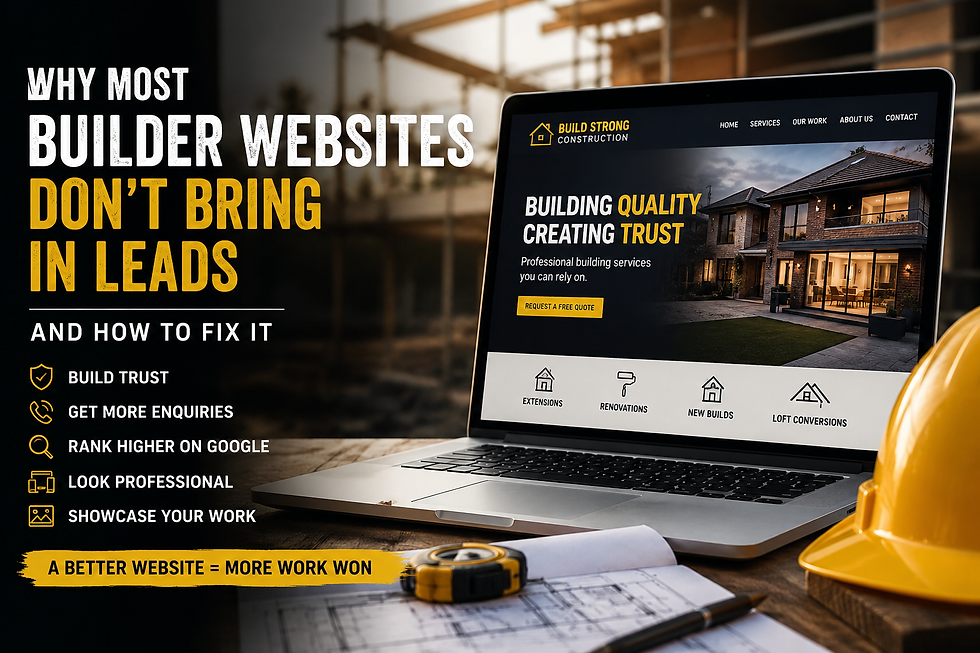
_edited.png)
A Solid Foundation Always Comes First

The truth is simpler: good websites and good buildings follow the same rules. If the foundations are weak, everything fails. If the design ignores the user, nothing works properly.
That thinking is exactly what shaped how I approach web design
A Solid Foundation Always Comes First
In construction, you never start with bricks. You start with groundworks, drainage, structure, and planning. Skip that, and you’re just building problems into the future.
Websites are no different.
Before I touch colours, fonts, or layouts, I focus on structure:
What is the purpose of the site?
Who is it for?
What action do we want visitors to take?
Is the navigation obvious from the moment they arrive?
Too many websites are built like rushed renovations — they look fine on the surface but underneath, everything is chaotic. Slow loading times, confusing menus, broken journeys. That’s the digital equivalent of damp in the walls.
Design Is Not Decoration — It’s Function
A lot of people think web design is about making things “look nice”. That’s like thinking architecture is just about paint colours.
I learned quickly that a beautiful finish means nothing if the door doesn’t close properly or the roof leaks.
Good web design should:
Guide the user naturally
Remove confusion
Highlight what matters
Make taking action effortless
Every button, every section, every space between elements should serve a purpose — just like every beam in a structure carries a load.
Speed, Strength, and Stability Matter Online Too
On-site, delays cost money. In web design, delays cost attention.
If a website loads slowly, users leave — just like clients walking away from a half-finished project site. That’s why performance is a core part of my build process.
Optimised images, and efficient structure aren’t optional extras. They’re structural requirements.
Think of it as insulation and steelwork for your website: invisible, but essential.
Clients Don’t Want Websites — They Want Results
One thing building taught me is that clients don’t care about the process. They care about the outcome.
No homeowner ever said, “I love your bricklaying technique.” They say, “It looks great and works exactly how I wanted.”
It’s the same online.
Business owners don’t want “a website”. They want:
More enquiries
More sales
More credibility
Less hassle managing their online presence
That’s why every project I take on starts with one question: what does success look like for this business?
The Renovation Mindset: Improving What Already Exists
Not every project is a new build. In fact, most are renovations — fixing outdated websites that no longer perform.
I assess:
What can be salvaged?
What needs rebuilding?
What’s costing performance or credibility?
Then I rebuild it properly — not just patch it up.
Why This Approach Works
Web design built with a contractor’s mindset is different. It’s practical, structured, and focused on longevity rather than trends.
Trends are like decorative features on a house. They come and go. Structure is what lasts.
That’s what I bring to every project at -diseño design studio — websites that don’t just look good on launch day, but keep performing long after.
Final Thoughts
Whether you’re building a house or a website, the principles don’t change:
Start with strong foundations
Prioritise function over decoration
Build for the people who will use it
Never compromise on structure
Because in the end, a website is just a digital building. And like any building, it should be solid, useful, and built to last.

Comments